
That Sharp Pull in Your Groin: A Common Hockey Injury
You dig in for a hard first stride to win a race for the puck, and something grabs high on the inside of your thigh. You finish the shift, but by the time you’re back on the bench, every push-off stings.
A groin strain is one of the most common injuries in the game, and it has a habit of coming back if it isn’t rehabbed properly. The good news is that the right strength work can lower your risk, and a clear rehab plan can get you back on the ice with confidence.
Here’s how.
What Is a Groin Strain?
A quick look at the anatomy
Your groin muscles, called the adductors, run along the inside of your thigh from your pelvis down to your thighbone. Their main job is to pull your leg in toward your body. They also help steady your pelvis and control your leg as it moves out to the side.
The muscle most often strained is the adductor longus. It sits right where your inner thigh meets your pelvis, which is why the pain is usually felt high in the groin.
The grades of groin strain
Strains are usually graded by how much of the muscle is damaged:
| Grade | What it means | What you might notice |
|---|---|---|
| Grade 1 | Mild overstretch with minor fibre damage | Tightness or mild pain, but you can usually keep skating |
| Grade 2 | A partial tear | Sharp pain, some weakness and pain with squeezing your legs together |
| Grade 3 | A complete or near-complete tear | Severe pain, major weakness, often bruising, and trouble walking |
Grades are a helpful guide, but they don’t tell the whole story. Two players with the same grade can recover at different speeds, depending on their strength, the exact spot of the injury and how they load it during rehab.
Why Hockey Groin Strains Are So Common
The skating stride is tough on your groin. Each time you push off, your leg drives out to the side and behind you. Your groin muscles have to work hard while they’re being stretched, slowing your leg down and then helping pull it back under you for the next stride. This is called eccentric loading, and it’s when muscles are most likely to strain.
The most common ways players get hurt include:
- a hard, explosive first stride to win a race or a faceoff
- a sudden stop or quick change of direction
- catching an edge and sliding into a split
- a leg getting pushed out wide during a battle along the boards
What raises your risk?
A few things are linked to a higher chance of a groin strain:
- a previous groin injury, especially one that wasn’t fully rehabbed
- inner-thigh muscles that are weak compared with the muscles on the outside of your hip
- jumping into heavy skating after the off-season without building up first
- fatigue late in a game or a long season
Preventing a Hockey Groin Strain: Build Capacity Before You Need It
Think of your groin muscles like a bank account. Every hard stride, stop and battle along the boards is a withdrawal. Strength training is how you make deposits. When the withdrawals start outpacing the deposits, that’s when strains tend to happen.
The good news is that a small amount of targeted work goes a long way. In a trial of 35 semi-pro soccer teams in Norway, players who did just one exercise, the Copenhagen adduction, had 41% lower odds of groin problems over the season than players who trained as usual. Teams did the exercise three times a week in preseason and once a week during the season.
That study was in soccer, not hockey, but both sports put huge demands on the groin through quick cuts and powerful strides. Older research in pro hockey players also linked weaker groin muscles to a higher chance of strains.
The Best Exercises to Prevent Hockey Groin Strains
These exercises build strength where hockey players need it most. Your physiotherapist can help you choose the right starting level:
| Exercise | How it’s done | Why it helps |
|---|---|---|
| Copenhagen adduction, short lever | Lie on your side with your top knee resting on a bench, then lift your hips and bottom leg up to meet it | A gentler starting point that builds strength without too much strain |
| Copenhagen adduction, long lever | The same exercise with your top ankle on the bench instead of your knee | A tougher version that loads the groin more, much like a powerful stride |
| Adductor squeeze | Lie on your back with knees bent and squeeze a ball or pillow between them | An easy, low-risk way to build strength, often used early in rehab |
| Slider side lunge | Stand with one foot on a slider, slowly slide it out to the side, then pull it back in | Trains the groin to control the leg as it moves out, like a skating stride |
| Lateral bounds | Jump side to side from one leg to the other and stick each landing | Builds power and control for quick, explosive skating |
Why slow, controlled lowering matters
Many of these exercises include an eccentric part, where the muscle works as it lengthens. Lowering your hips slowly in a Copenhagen or sliding out slowly in a side lunge are good examples. This trains your groin for the exact demand it faces when your leg drives out during a stride.
Groin Strain Rehab at a Glance
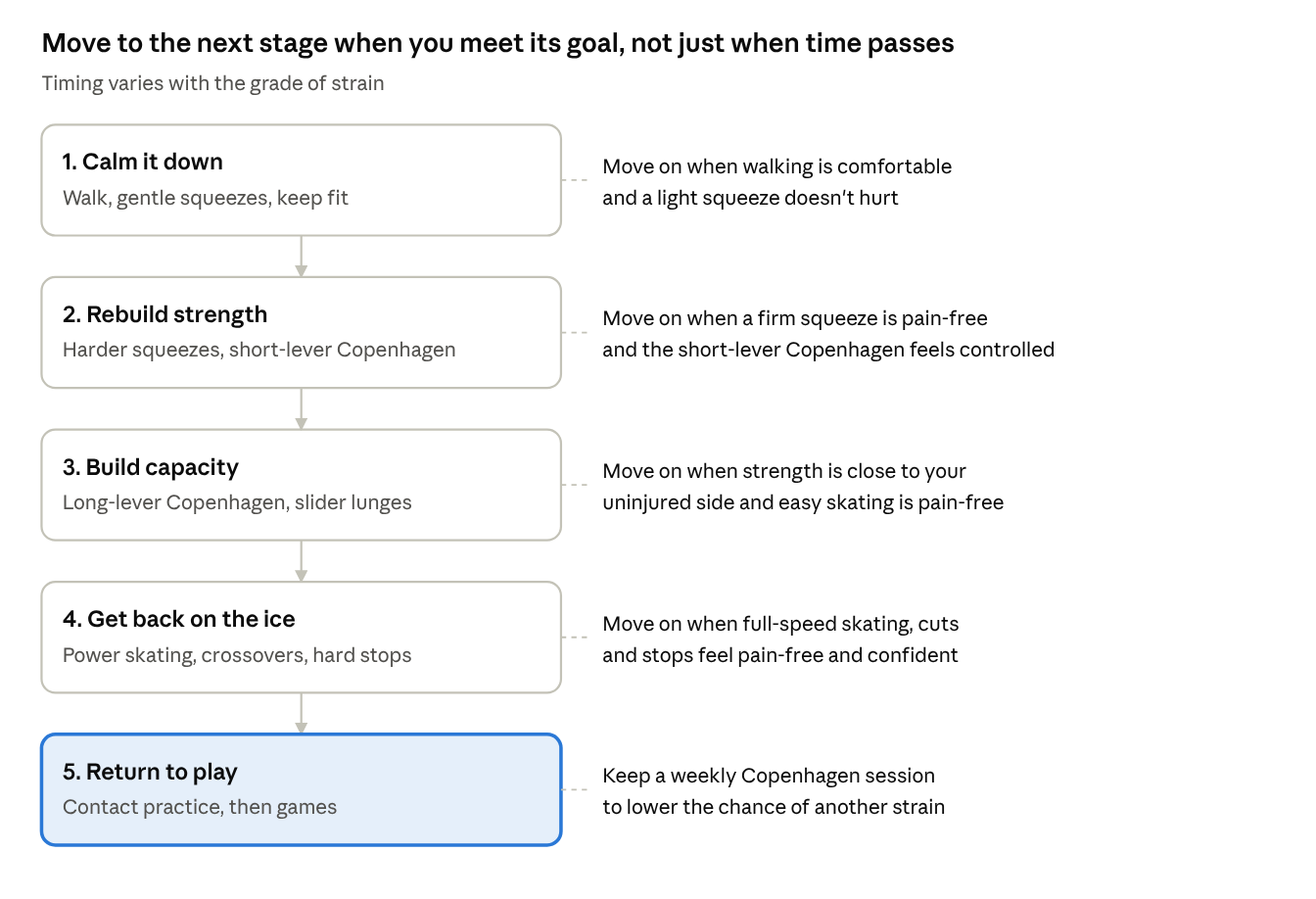
Each stage has a goal to hit before you move on. The next section walks through what happens in each one.
Hockey Groin Strain Rehab, Stage by Stage
Rehab moves forward when you hit the goals for each stage, not just when a certain number of days have passed. Timelines vary with the grade: a mild strain may settle in a week or two, a partial tear often takes several weeks, and a complete tear can take months and may need a surgeon’s opinion.
Stage 1: Calm it down
In the first few days, the injured tissue is starting to repair. The goal is to protect it without shutting everything down. You’ll usually walk as comfortably as you can, try gentle, low-effort squeezes that don’t hurt, and keep the rest of your body moving with upper-body work or easy cycling if it’s pain-free.
You’re ready to move on when walking feels comfortable and a light squeeze doesn’t hurt.
Stage 2: Rebuild strength
Now the focus shifts to steadily loading the healing muscle so it gets stronger. Squeezes get harder, and you’ll add exercises like side-lying leg lifts and the short-lever Copenhagen. Hip and core strength work fits in here too.
You’re ready to move on when a firm squeeze is pain-free and you can do the short-lever Copenhagen with good control.
Stage 3: Build capacity
This stage prepares your groin for the demands of hockey. You’ll progress to the long-lever Copenhagen, slider side lunges and single-leg work, plus easy jogging or light skating in straight lines.
You’re ready to move on when your groin strength is close to your uninjured side and easy skating is pain-free.
Stage 4: Get back on the ice
Now your rehab looks like hockey. Power skating, crossovers, quick starts, hard stops and lateral bounds are added step by step, usually in non-contact practice first.
You’re ready to move on when you can skate at full speed, cut and stop hard without pain or hesitation.
Stage 5: Return to play and stay there
You return to contact practice, then games. The work doesn’t stop here, though. Keeping a weekly Copenhagen session in your routine is one of the best ways to lower your chance of another strain.
The Bottom Line on Hockey Groin Strains
Here’s a quick recap:
- The skating stride puts heavy, stretching loads on your groin muscles.
- Groin strains range from a mild overstretch to a complete tear.
- Copenhagen adduction training has good evidence for lowering the risk of groin problems.
- Rehab works best in stages, moving forward when you hit each goal, not just when time passes.
- Keeping up groin strength work after you return is key to staying on the ice.
At Allied Physiotherapy, our sports physiotherapy team works with hockey players of all levels, from minor hockey to beer league. Whether you’re nursing a fresh strain or want to stay ahead of one this season, book an assessment and we’ll build a plan that gets you skating strong.
References
Harøy, J., Clarsen, B., Wiger, E. G., Øyen, M. G., Serner, A., Thorborg, K., Hölmich, P., Andersen, T. E., & Bahr, R. (2019). The Adductor Strengthening Programme prevents groin problems among male football players: A cluster-randomised controlled trial. British Journal of Sports Medicine, 53(3), 150–157. https://doi.org/10.1136/bjsports-2017-098937